
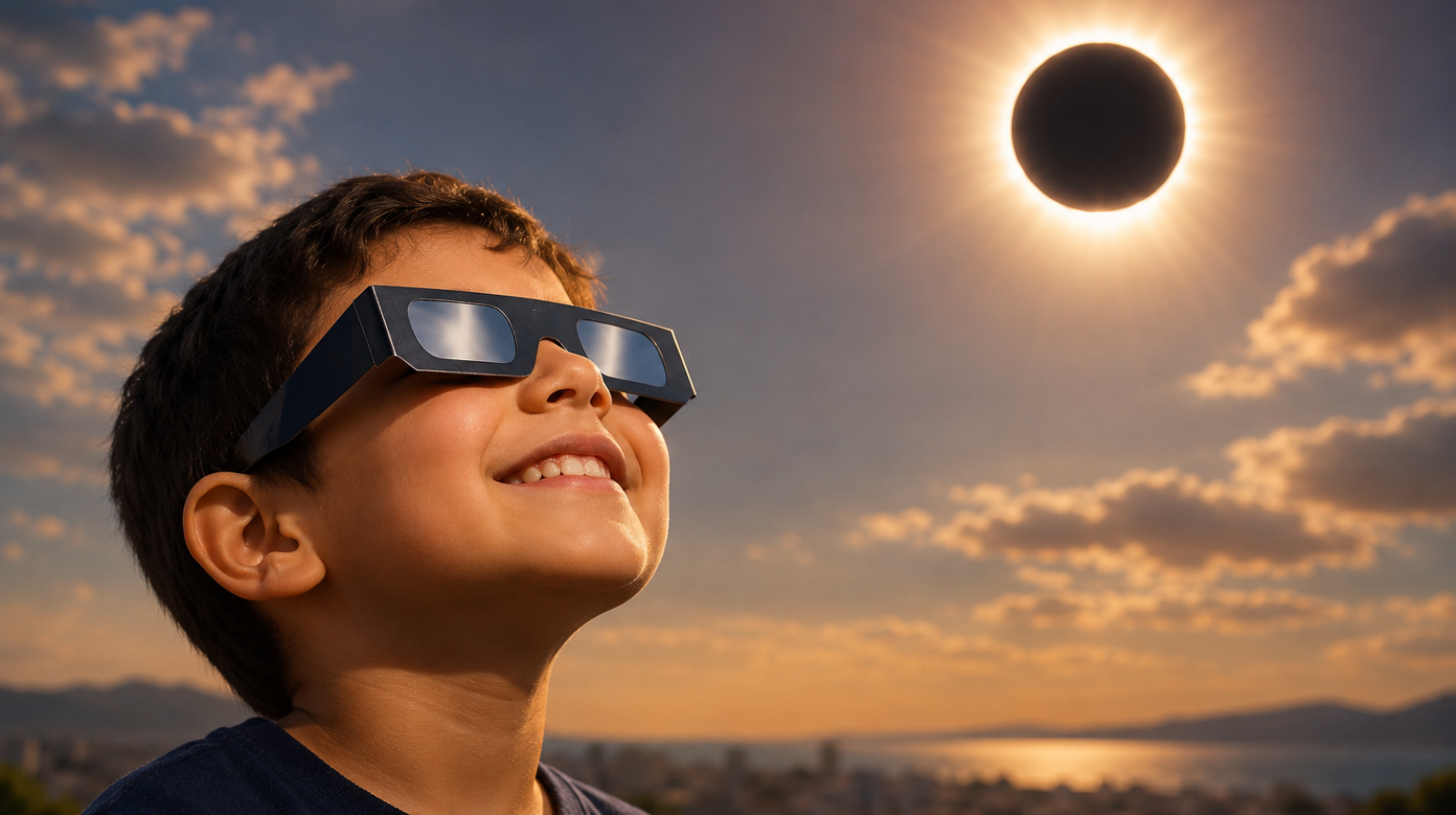
Solar Eclipse 2026: Everything You Need to Know to Protect Your Eyes in Morocco
On August 12, 2026, a total solar eclipse will be visible across a large part of the globe, with the path of totality crossing Spain and Portugal, while a significant partial eclipse will be observable from northern Morocco. This exceptional astronomical event is generating curiosity and excitement, but it also presents a real and underestimated medical risk: irreversible damage to the retina.
In this article, Docdialy explains how to safely observe the solar eclipse 2026, what the risks are for your eyes, and when you should consult an ophthalmologist.
Solar Eclipse 2026: What You Need to Know
Date and Visibility
The total solar eclipse on August 12, 2026, will be one of the most spectacular eclipses of the 21st century. The path of totality will cross the North Atlantic, Iceland, Spain (including Madrid), the Balearic Islands, and Algeria.
From northern Morocco, including Tangier, Tetouan, and Nador, a significant partial eclipse will be visible, with solar coverage potentially exceeding 80%.
Duration of the Eclipse
Totality will last approximately 2 minutes and 18 seconds in the central areas of the path. From Morocco, the partial eclipse will last around 1 hour and 30 minutes, with the maximum occurring at approximately 11:30 a.m. local time.
Why Is Looking at an Eclipse Without Protection Dangerous?
The sun continuously emits ultraviolet (UV) and infrared (IR) radiation, which can burn the retina, the light-sensitive membrane at the back of the eye. Under normal circumstances, pain and the natural pupil reflex prevent us from looking directly at the sun for too long.
During a solar eclipse, two factors can make the danger less obvious:
- The reduced brightness decreases glare and the natural reflex to look away.
- UV and IR radiation remain intense even when most of the solar disk is covered.
As a result, you may be able to look at the eclipsed sun without experiencing immediate pain for several seconds — enough time to cause permanent retinal damage.
Solar Retinopathy: The Eye Injury Associated With a Solar Eclipse
What Is Solar Retinopathy?
Solar retinopathy is a photochemical burn affecting the macula, the central area of the retina responsible for sharp, detailed vision. It can occur several hours after exposure and may be irreversible in severe cases.
Symptoms of Solar Retinopathy
Symptoms may include:
- Blurred or distorted central vision, appearing several hours to several days after exposure
- A central scotoma: a dark or gray spot in the center of your visual field
- Distortion of straight lines (metamorphopsia)
- Increased sensitivity to light
- Headaches
Important: symptoms may appear 12 to 24 hours after exposure. Do not assume you are safe simply because you feel nothing immediately after observing the eclipse.
Treatment
There is currently no established curative treatment for solar retinopathy. In mild to moderate cases, partial visual recovery may occur over 3 to 6 months. Severe cases can result in permanent visual impairment.
How to Safely Observe the Solar Eclipse 2026
Certified Eclipse Glasses: Where to Get Them
To safely observe a solar eclipse, you must use specially designed solar viewing glasses that comply with the ISO 12312-2 standard. These glasses reduce solar brightness by a factor of approximately 100,000, allowing the eclipse to be observed safely.
Our advice: get your certified eclipse glasses directly from a pharmacy. This is one of the most reliable and accessible options in Morocco, and a pharmacist can help you check the product's compliance before purchasing it.
- Buy them from a pharmacy or certified suppliers, such as opticians or astronomy stores.
- Check that the ISO 12312-2 certification is marked on the frame.
- Inspect the glasses before use: there should be no scratches, tears, or punctures.
- Never use ordinary sunglasses, photographic filters, CDs, or X-ray film. None of these provide sufficient protection against solar radiation.
On the day of the eclipse, some pharmacies may quickly run out of stock, so it is better to get your glasses a few days in advance. If you are looking for a pharmacy that is open on the day of the eclipse or outside regular opening hours, check the on-call pharmacies available on Docdialy → docdialy.com/pharmacies-de-garde
Indirect Projection
A safe and accessible alternative is pinhole projection. Make a small hole in a piece of cardboard and project the image of the sun onto a white surface. The image of the eclipse can then be viewed clearly without exposing your eyes directly to sunlight.
Totality Only: When Eclipse Glasses Are Not Necessary
ONLY during the few minutes of complete totality, when the solar disk is entirely covered by the Moon, is it safe to observe the eclipse with the naked eye.
As soon as even the smallest portion of the sun becomes visible again, put your eclipse glasses back on immediately.
From Morocco, where only a partial eclipse will be visible, eclipse glasses must be worn throughout the entire event.
People at Particular Risk
Some people may be more vulnerable to eye damage during a solar eclipse:
- Children: their lenses transmit more UV radiation, making their eyes more vulnerable.
- People with pre-existing eye conditions
- Contact lens wearers: contact lenses provide no protection against solar radiation.
- People taking certain photosensitizing medications
When Should You See an Ophthalmologist After the Eclipse?
Seek medical attention promptly if, after the eclipse, you notice:
- A dark spot in the center of your visual field
- Distorted or blurred vision
- Straight lines appearing curved or distorted
- Unusual sensitivity to light
Do not wait. Solar retinopathy does not cause pain, which is what makes it particularly deceptive. A prompt examination by an ophthalmologist, including tests such as OCT or angiography when appropriate, can help assess the extent of retinal damage.
- Ophthalmologist in Morocco → docdialy.com/ophtalmologue
- Teleconsultation for initial guidance → docdialy.com/teleconsultation
- On-call pharmacies for your eclipse glasses or any urgent need → docdialy.com/pharmacies-de-garde
Conclusion
The solar eclipse 2026 on August 12 will be a rare and spectacular astronomical event. Enjoy it, but protect your eyes.
Watching the eclipse without certified protection can cause permanent retinal damage and may result in irreversible vision loss.
Get your certified eclipse glasses from a pharmacy now, and if you experience any visual symptoms after the eclipse, consult an ophthalmologist through Docdialy without delay.