
Endodontics: Understanding Root Canal Treatment to Save Your Tooth
The term may sound intimidating, but endodontics is now one of the most reliable dental treatments available. Better known as root canal treatment, it helps preserve a tooth whose inner tissue is infected or inflamed, rather than removing it.
Many Moroccans living abroad take advantage of their holidays in Morocco to undergo dental treatment. If you need a root canal, it is best to plan ahead: the procedure may require several appointments, and the crown placed afterward often takes time to manufacture. Booking an appointment as soon as you arrive allows you to complete the treatment before leaving.
1. What Is Endodontics?
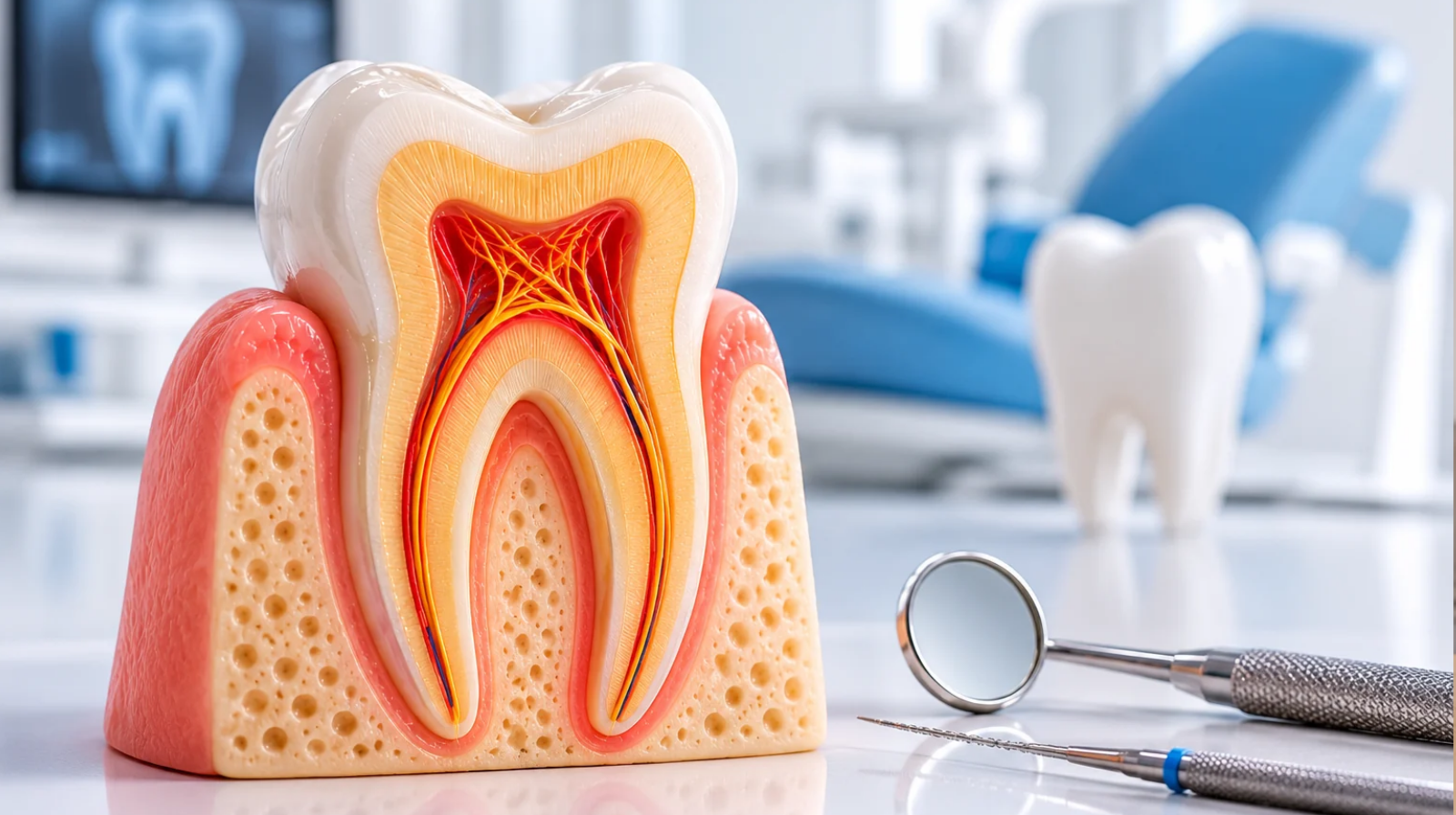
Endodontics is the branch of dentistry that deals with the inside of the tooth. At the center of each tooth is the dental pulp, a soft tissue containing nerves and blood vessels, located inside canals that extend down to the tips of the roots.
When the pulp is affected by deep tooth decay, a crack, or an injury, it can become infected. The treatment involves removing the damaged pulp, cleaning and disinfecting the root canals, and then sealing them tightly with a filling material.
2. When Is Root Canal Treatment Necessary?
Several signs should prompt you to see a dentist:
-
Spontaneous pain, sometimes throbbing, that may wake you up at night.
-
Sensitivity to hot or cold that persists long after contact with the affected tooth.
-
Pain when chewing or touching the tooth.
-
Swelling of the gums or cheek, sometimes accompanied by a small pus-filled bump.
-
A tooth that becomes darker or changes color.
Important: An infection can also develop without causing pain. This is why regular dental checkups and X-rays are essential.
3. How Is Root Canal Treatment Performed?
The procedure generally involves the following steps:
-
Local anesthesia: The affected area is numbed, making the procedure generally painless.
-
Opening the tooth: The dentist creates an opening to access the pulp chamber.
-
Removing the pulp: The infected or inflamed pulp is removed. The root canals are then cleaned and shaped using fine instruments and disinfecting solutions.
-
Sealing the canals: The canals are filled with a material that creates a tight seal.
-
Restoring the tooth: The tooth is restored, often with a dental crown, particularly in the case of molars.
Treatment can usually be completed in one or two appointments, depending on its complexity. Straightforward cases are handled by general dentists, while more complex cases, such as molars with multiple canals or retreatment procedures, are often referred to an endodontist, a dentist specializing in these treatments.
4. Is Root Canal Treatment Painful?
Thanks to local anesthesia, the procedure itself is generally no more painful than having a cavity treated.
Some mild sensitivity may occur for a few days following the procedure. According to the European Society of Endodontology (ESE), fewer than 5% of patients experience persistent pain 3 to 5 years after treatment.
5. What Is the Success Rate of Root Canal Treatment?
The European Society of Endodontology (ESE) reports that cohort studies show success rates for initial root canal treatments ranging from 80% to over 90%.
Studies conducted in the general population indicate that nearly 90% of treated teeth remain in place 10 years after treatment. With proper care, a tooth that has undergone root canal treatment can last a lifetime.
The quality of the final restoration, whether a crown or a filling, plays a major role. A tooth that is not properly protected may fracture or become reinfected.
6. Root Canal Treatment or Tooth Extraction?
The alternative to root canal treatment is tooth extraction, usually followed by replacement with a dental implant, bridge, or denture. This option generally takes longer and is often more expensive.
Whenever possible, preserving your natural tooth remains the preferred option recommended by professional dental organizations.
7. Dental Emergencies: When Should You Seek Immediate Care?
Rapidly spreading facial swelling, fever, or difficulty swallowing or breathing may indicate an infection that is spreading.
These symptoms require urgent medical attention.
8. After Root Canal Treatment: Essential Care Tips
To protect your tooth and support healing, follow these recommendations:
-
Avoid chewing on the treated side until the permanent restoration has been placed.
-
Take any prescribed pain medication according to your dentist's instructions.
-
Return for your permanent crown or filling appointment, as this restoration protects the tooth in the long term.
-
Continue brushing carefully and attending regular dental checkups.
If pain increases instead of gradually improving, or if swelling or fever develops after treatment, contact your dental office promptly.
If your toothache has already started before you leave for your holiday, it is best not to postpone treatment. An infection can worsen during travel, making it difficult to continue treatment with the same dentist.
9. Which Dental Specialist Should You Consult in Morocco?
A general dentist can diagnose the problem and perform most root canal treatments. For complex cases or retreatment procedures, they may refer you to an endodontist.
Dental X-rays are essential before and after the procedure.
If you experience severe toothache at night or during the weekend, on-duty pharmacies can provide advice while you wait for your dental appointment. However, in cases of significant facial swelling or difficulty breathing, call 141 (SAMU) or 15 (Civil Protection).
-
All dental specialties: docdialy.com/specialites
-
Radiologist: docdialy.com/radiologue
-
On-duty pharmacies: docdialy.com/pharmacies-de-garde
-
General practitioner: docdialy.com/general-practitioner
10. Frequently Asked Questions
Is a tooth that has undergone root canal treatment considered dead?
The tooth no longer contains dental pulp, but it remains firmly attached to the jawbone and continues to function normally.
Is a dental crown always necessary after root canal treatment?
Not always, but a crown is often recommended for molars and premolars, as these teeth are more vulnerable to fractures.
Are antibiotics enough to treat a root canal infection?
No. Antibiotics may help manage certain infections, but they cannot replace the cleaning and disinfection of the root canals.
11. Conclusion
Root canal treatment has a bad reputation, but it can save a natural tooth in the vast majority of cases, without pain during the procedure.
Avoiding delays until the pain becomes unbearable remains one of the best ways to preserve your natural teeth.
Persistent toothache or swollen gums? Book an appointment with a dentist near you on Docdialy.
Book your appointment on Docdialy: docdialy.com/specialites | docdialy.com/teleconsultation
References
-
European Society of Endodontology (ESE) – The Benefits of Endodontic Therapies. e-s-e.eu
-
American Association of Endodontists (AAE) – Root Canal Treatment, Patient Information. aae.org
-
American Dental Association – Root Canals. mouthhealthy.org
-
NHS – Root Canal Treatment. nhs.uk
Disclaimer: This article is provided for informational purposes only and does not replace a consultation with a healthcare professional.